From Volunteer to CEO, A SIPA Alumna Discusses Her Journey Working on Social Impact in India
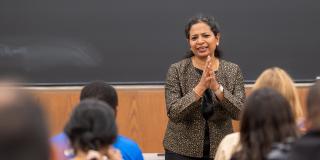
You might say social service is in the DNA of Meenakshi Ramesh MPA-GL ’25. Her father, who had worked at a financial institution in India, passed away unexpectedly when she was 30 years old. Ramesh recalls being flooded with letters from people who knew him, detailing how he’d helped them and expressing gratitude for his generosity.
“He had given funds for treatment, for somebody’s child’s education – always something,” she says. “He gave so much of his time. I felt I had an obligation to carry that legacy forward.”
Carry it forward she has: For the past 25 years, Ramesh has dedicated herself to social service, rising from a part-time volunteer at Pratham Education Foundation to holding top leadership roles at United Way Chennai, a nonprofit that matches corporate donors with grassroots community projects, and the Antara Foundation, which works to improve maternal and child health and nutrition across India. In 2013, she cofounded the Oorvani Foundation, a nonprofit committed to civic engagement through independent media and open data platforms.
And now, Ramesh has come full circle in her journey by returning to Pratham last fall as its new CEO, leading a team of 5,000 and managing an annual budget of roughly $50 million. Pratham focuses on improving the quality of education for Indian children and women and providing vocational training for youths. Today, Pratham is one of the largest NGOs in India.
“What I saw in her was an unparalleled commitment to her heart’s vocation, and the transformative resilience to keep growing into it,” says Yumiko Shimabukuro, codirector of the Master of Public Administration (MPA) in Global Leadership program at SIPA. “What stays with me most is how deeply she listened, with openness and boundless curiosity. She reminded me that the best leaders remain learners.”
Ramesh spoke with SIPA News about the spark for her career in social impact work, why she came back to school for her MPA, and her ambitious goals as CEO of Pratham.
You first went to graduate school in the early 1990s, earning your MBA during a significant period in India’s history. The opportunities that suddenly opened to you compelled you to engage in social impact work. Can you explain that?
When my husband and I went into business school, India was a completely closed, low-opportunity country. These were the days of the “License Raj,” when the government was running everything and you had to get permission to open an industry. We were a socialist country.
But then we had the Indian economic crisis in 1991, and the government liberalized. So when my husband and I graduated, the country had opened up to foreign investment. It was like night and day. And he and I were on the cusp of opportunities that I felt we did nothing to really deserve. We just happened to be in the right place at the right time. That really makes you stop and think that if by luck and sheer chance you could do so well, you have an obligation to give back and work for the larger good.
You kicked off your career in social impact work with a volunteer position at Pratham in 2001. How did that come about?
When I had my younger child, I didn’t want to go back to full-time work right away, so I felt like I had time on my hands. Very serendipitously, I met the founder of Pratham. It was a very young organization then and they were looking for people to join them. I would go for two to three hours a day because I had a six-month-old baby at the time, and I just loved the work so much that I stayed for eight years. For the last five of those eight years, I worked full time as the CFO. I eventually had to move on to other cities, but I feel like I always left a piece of my heart there, and I always stayed in touch.
When you came to SIPA in 2024, you already had decades of social service work under your belt. So why go for your MPA at that point?
The organization that I worked with at the time was focusing only on city- or state-level projects in India, and the mission of the organization itself focused on corporate donors. So I would go to a particular company and do what they wanted from a project perspective.
But I realized many countries in the Global South are essentially grappling with the same challenges: poor learning levels, poor health, poor safety, poor rights for women. Increasingly I wanted to work in an organization that sits at the intersection of implementation and policy, where you not only fix what’s not working right now but also collaborate with the government to fix policy so that we don't face this problem in the next five years. Because then the outcome is good not just for my organization, but for the entire country. I discovered that SIPA had recently introduced the Global Leadership track, and I really felt that by enrolling I could get a very good understanding of the challenges across the world and learn proactive, systemic approaches to solving them.
You credit your family with giving you the nudge you needed to apply to SIPA. Strong relationships are undeniably powerful for pushing us to reach our potential and supporting us in our endeavors.
Absolutely. In fact, one of the main things I have taken from my SIPA experience is the value of relationships and networks. At a place like SIPA, you meet so many intelligent and interesting people who are all concerned with the same kinds of issues and are interested in solving these issues. If you feel like you need advice, you can call somebody, or chip in to offer help to someone else.
I have really dipped into this network. For example, I work in India, but Pratham takes our pedagogical learnings and tries to help organizations in other countries in the Global South. One of the first countries we wanted to work in was Colombia. So I reached out to my classmate, who’s based in Colombia at a nonprofit. Now Pratham has a partnership with the organization that my classmate heads.
I think if I had worked with these people in a different context, our relationships might’ve been different. To have been friends with them in an intellectually stimulating environment makes all the difference.
Pratham focuses on three primary areas: elementary school, vocational training for youths, and education for girls and women. Can you discuss the work you do in each of these verticals?
First, we work directly in villages or with government schools. The government of India runs a massive school network — there is a school in at least one out of every two villages, and we have over 700,000 villages in India. But the schools didn't have enough infrastructure or enough teachers, so kids weren't learning. If a child cannot read, what is the point of putting any curriculum in front of that child?
So Pratham introduced an assessment in 2005 called the Annual Status of Education Report. That biennial survey serves as a baseline for the government and for other organizations to structure their work around. At Pratham we offer accelerated reading programs for these children in grades one through five.
Second, we have a vocational training program for young adults. We realized that there is a whole generation of children who went through school without really learning much. Now they're 15 to 18 years old, but they don't have any gainful employment. So we started vocational training, helping them become plumbers, electricians, mechanics, chefs.
Third, it's quite common in India that young women are not allowed to complete school either because the higher secondary school is too far away or the parents decide they should get married. Roughly 40 percent of our women under 30 have not completed 10th grade. These women came to us and said, “We'd like to study, too.” So we introduced a back-to-school program for young women who didn't get to finish their education.
Looking ahead, what are some of your goals as Pratham’s new CEO?
I have a team of 5,000 people, largely composed of community mobilizers. We work in over 10,000 villages in India. In my view, our next big challenge is to figure out how we can collaborate to achieve universal foundational literacy for our children and create jobs for our young people by 2047. [The Indian government has set a number of development targets for 2047 as it will mark 100 years of Indian independence.] By 2047, we hope all our children will be in school and learning well, and our young people will have jobs that make them economically upwardly mobile. Those are some of the things we want as part of the larger national mission.