SIPA’s Class of 2026 Celebrates Graduation
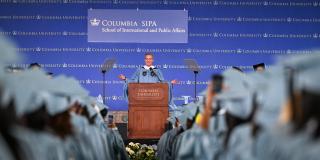
Around 650 graduates and nearly 3,000 guests, friends, and family members gathered on Columbia University’s South Lawn on May 21 to celebrate the Columbia SIPA Class of 2026.
As umbrellas dotted the lawn and graduates cheered through the drizzle, Dean Keren Yarhi-Milo reflected on the moment facing the graduating class. “Periods of disruption are often the moments when public service matters most,” she told students. “At a moment when cynicism is often mistaken for wisdom, the decision to enter public service matters deeply.”
The ceremony’s featured keynote speaker was Eric Garcetti MIA ’93, who served as mayor of Los Angeles and later as US ambassador to India. He urged graduates to see themselves not simply as caretakers of existing institutions, but as the generation responsible for rebuilding them. “You inherited a burning building,” Garcetti said. “But you are not consigned to merely putting out the flames. You are the generation that gets to decide what is built atop the ashes.”
Throughout the ceremony, speakers reflected on the shifting landscape of higher education and the global economy. Dean Yarhi-Milo described a generation whose education extended far beyond the classroom—shaped by difficult conversations across differences, global conflicts, democratic backsliding, trade disputes, and the rapid rise of AI. She urged graduates to embrace intellectual humility and to seek out “the harder rooms,” where disagreement sharpens judgment and leadership.
Student speakers Aaliyah Khwaja MIA ’26 and Marjan Amiri MIA ’26 reflected on the deeply personal journeys that brought them to SIPA. Khwaja spoke about the responsibility of public service in uncertain times. Quoting Sheikh Zayed, she encouraged graduates to build something that “will outlast us.” Amiri recounted her path from Afghanistan to Germany, Canada, and then Columbia, while dedicating her degree to Afghan women like her grandmother and girls denied access to education. “Policy is not just numbers on a ledger or words in a treaty,” she said. “It is the difference between a closed door and a classroom.”
The ceremony also recognized faculty excellence and student achievement, including SIPA Awards for Outstanding Teaching, which were awarded to Professor Goksenin Ozturkeri for Renewable Energy Project Finance Modeling, and Professor Thomas J. Christensen for Seminar on International Strategy.
A processional of graduates draped in Columbia blue robes, some waving flags or wearing sashes from their respective countries, crossed the stage before classmates, loved ones, and faculty mentors. Rain continued to fall across the South Lawn of the main campus, creating an atmosphere that, if anything, only amplified the emotion and celebration of the day.
At the close of her remarks, Yarhi-Milo reminded graduates that SIPA would remain a permanent anchor in their lives. “The world needs this class – this specific, battle-tested, 70-countries-in-one-room class – to lead with judgment, and to do the deeply human work that no algorithm can do for you,” she said.
Taking up that call to human-centered leadership, Garcetti challenged the graduates to look toward the future by actively shaping the global systems and institutions of the coming decades. “So tonight, celebrate what you have achieved," he said. "And tomorrow, go build something,” prompting thunderous applause.
After the ceremony, and still clutching umbrellas, graduates and guests gathered to celebrate at a reception in Ancell Plaza.