Image
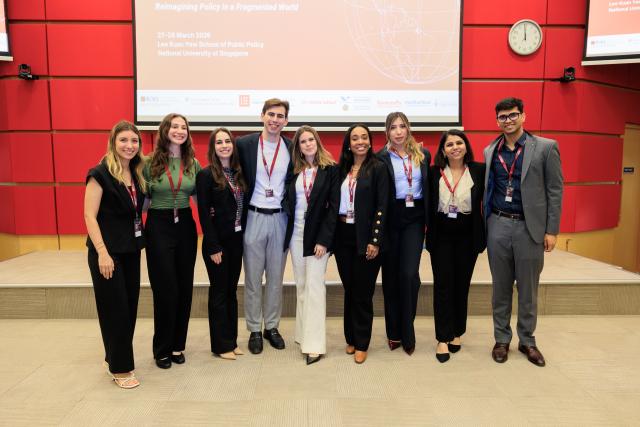
On March 27–28, Columbia SIPA sent four teams of students to Singapore to compete at the annual Global Public Policy Network (GPPN) conference. Thirty teams from across the network’s eight member schools participated in this year’s competition, hosted by the Lee Kuan Yew School of Public Policy at the National University of Singapore.
The annual GPPN conference offers students the opportunity to present their policy proposals to deans and faculty from some of the world’s leading schools of public affairs, and to connect with their peers from around the globe. This year’s theme, Reimagining Policy in a Fragmented World, challenged participants to confront the realities of rising polarization, declining institutional trust, geopolitical tension, and fragmented governance, and to propose bold, innovative solutions where traditional policy approaches often fall short.
Prior to the conference, nine students from SIPA met with Sarah Holloway, senior lecturer in the discipline of international and public affairs and director of the Master of Public Administration program, and Tsuya Yee, dean of students and associate dean for student affairs, to refine their proposals. Holloway also served on the faculty jury at the conference.
Team “Preventing Election Collapse in Fragile States: A Tailored Electoral Pathway for Haiti” — Esmira Isgandarova MPA ’26, Micaela Carolina Camarena Verdía MIA ’26, and Sofía Marrero MIA ’26 examined how prolonged instability, gang violence, and institutional erosion have undermined Haiti’s capacity to hold credible elections. Rather than applying a one-size-fits-all model, the team prioritized minimum security conditions, interim governance arrangements, and internationally supported institutional rebuilding.
Team “Humanitarian Identity Corridors in ASEAN: Reconnecting People to States in a Fragmented Region” — Claire Kirshenbaum MPA ’27 and Kyra Szabo MIA ’27 introduced a proposal for an ASEAN Humanitarian Identity Corridor that would enable consent-based data-sharing between humanitarian registration systems and national ID frameworks, without creating a universal identifier or undermining national sovereignty. The proposal aims to advance access to essential services for displaced and stateless populations across the region.
Team “Rotational Labor Mobility for Ageing Economies: A State-Led System to Connect Surplus Workers to Structural Labor Shortages” — Anurag Mishra MPA ’27 and Shazia Azmat Fatima Rehman MPA ’26 argued that global ageing is creating structural labor shortages in advanced economies while labor-surplus countries struggle to generate sufficient domestic opportunity. Their proposal advances a state-led rotational labor mobility system, complete with a publicly managed matching platform, to deploy workers on time-bound, rights-protected contracts with guaranteed return pathways.
Team “Buying Back Democracy: Why Vulnerable Youth Need Paid Civic Engagement” — Achilleas Tsirgis MPA ’26, Carly Bainbridge MPA ’26, and Valentina Vidotto MPA ’26 addressed the “paradox of volunteering” in Europe: the young people most vulnerable to radicalization and populist influence are precisely those who cannot afford unpaid civic engagement. The team proposed an EU-funded paid community service program for disadvantaged youth aged 16–18, implemented through ESF+ and Cohesion Policy structures, to build social capital and ideological anchoring in at-risk communities. The team advanced to the final round of competition.
First prize was awarded to a team from the London School of Economics for its project, “Overcoming Fragmentation Through Urban Mobility Reform in South Africa," which proposed a "Taxi Integration Act 2026” to formalize South Africa’s vast informal minibus taxi sector — serving nearly 11 million daily commuters — through a three-pillared approach addressing labor protections, route integration, and violence reduction.
The conference also included an alumni lunch and a river cruise, providing students with additional opportunities to connect with peers and GPPN alumni across the network.
“Beyond the competition itself, one of the most valuable parts of the experience was the people: meeting policy-minded young professionals, building real friendships, and being reminded that the next generation of policymakers is thinking seriously about the same problems from very different vantage points,” said Carly Bainbridge MPA ’26.
Reflecting on the experience, Holloway emphasized the pragmatism of student proposals. “What struck me most was not the ambition, but the realism,” she noted. “These students came with clear plans and an honest understanding of what it would actually take to make their ideas happen. How do we design policies that are bold enough to matter but grounded enough to get built?”
More broadly, Yee noted that SIPA remains an active and engaged member of the GPPN. She highlighted that with the Munk School of Global Affairs & Public Policy at the University of Toronto’s recent elevation to full membership, SIPA launched a new dual-degree program and will welcome its first cohort of Munk dual-degree students in fall 2026. Looking ahead, the GPPN executive committee is in active discussions about thoughtful ways to expand the network into new regions while keeping the student exchange experience at its center.
Founded in 2005, the Global Public Policy Network (GPPN) is a partnership between Columbia University; Sciences Po Paris; London School of Economics and Political Science (LSE); Lee Kuan Yew School of Public Policy at the National University of Singapore; FGV-EAESP in São Paulo; the Graduate School of Public Policy (GraSPP) at the University of Tokyo; the Hertie School in Berlin; and the University of Toronto’s Munk School of Global Affairs & Public Policy. Under the auspices of the GPPN, SIPA offers students the opportunity to pursue two degrees, at two different universities on two continents in two years, providing a truly global perspective. In spring 2027, LSE will host the GPPN conference in London.