Image
The heat advisory that flashes on your weather app might just save your life today – and even more so in the future. A new paper published by SIPA scholars in PNAS shows that if US weather forecasts become more accurate over time, that could save thousands of lives from heat-related deaths, even as climate change increases the likelihood of extreme temperatures.
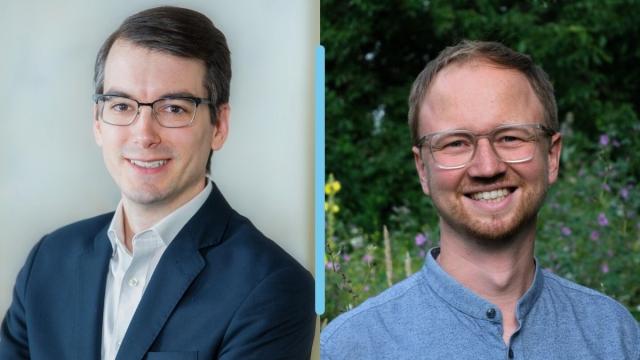
Jeffrey Shrader, an environmental economist and associate professor at SIPA, and Stephan Thies, a sustainable development PhD candidate at SIPA, led a team of researchers in surveying professional weather forecasters to gauge how much more accurate they think short-range US temperature forecasts can get. If those predictions pan out, researchers estimate that improvements in accuracy could reduce annual heat-related mortality by 18 percent by 2100. That number could be even higher – about 25 percent – if improvements happen more rapidly.
In a SIPA News Q&A, Shrader and Thies discuss their research, why forecast accuracy will become an important tool in adapting to climate change, and how AI is making weather models more predictable – as long as human forecasters are still overseeing them.
This interview has been edited for length and clarity.
Your paper finds that as weather forecasts become more accurate, they have the potential to reduce heat-related mortality. How did you reach that conclusion?
Jeffrey Shrader: We start with this fact that, right now, more accurate forecasts save lives. On days when forecasts are more accurate, mortality rates from [high] temperatures decrease. We then do statistical analysis to understand how that relationship might or might not evolve over the coming century. That leads us to the projections that future forecast improvements will save even more lives.
Another way to say this: we have really great forecasts right now. In the US and places such as Europe, forecasts are remarkably accurate. Some folks see that and say, “Maybe we're already doing almost as well as we could do. Maybe we’ve gotten as many of the returns as we're going to get from investing in forecasts.” One of the things that we're showing is no. According to our estimates, there’s a lot of room both to improve forecasts and for that improvement to continue to reduce mortality from temperature.
Stephan Thies: When it comes to climate change, since there are going to be more and more of these extremely hot days, we find that these very hot days are the ones where the benefits of forecasts are the largest. Even without climate change, forecasts are going to help us. But the more climate change we expect, the more forecasts are going to help us offset some mortality.
Why are temperature forecasts so effective at saving lives on hot days?
Shrader: We were trying to establish this initial fact, but there is still room for research that helps us understand what drives this fact. I'll say a few things that we found in that follow-on work, and which have been shown in prior research.
There are individual actions and public – or community – actions that are really valuable.
Individual actions are simple things like people choosing whether to go outside and garden, or play sports – or do something else. If they think it's going to be a nice day outside, they're going to plan to do that. If it turns out to be really hot, then that can be deadly for some folks. With an accurate temperature forecast, some people might decide to delay such activities.
There are also things on the community or policy level. Weather forecasts play an important role in mobilizing public health authorities and community health workers to go and check on vulnerable populations. Because that takes time and coordination, there's an important role for early warning systems.
For communications to be effective, I imagine the public has to trust the weather forecasts to be pretty accurate. In what ways did experts think forecast accuracy could be improved?
Thies: When we asked forecasters, “What should we invest in to improve forecast accuracy?” they mentioned Earth observation systems and models – investments, basically, in better data and better models.
When it comes to what we should do to improve the value of forecasts to the public, forecasters say: “We need better communication.” The human element is crucial. There's evidence that the models alone, they do a good job. But the add-on of human interaction improves the forecast substantially.
When we do our extrapolations into the future of how much the forecast will help, we try to get a feeling for how better forecasts will change how people react to forecasts. For our main results, we are holding the relationship of how people respond to forecasts constant and assume they continue reacting as they do currently. But in the future, as forecasts get much, much better, people might rely much more on these forecasts. When we try to incorporate these reactions, forecasts tend to save even more lives, but our results become more uncertain as it is really hard to predict how people will use such accurate forecasts.
Overall, I would say it's a bit ambiguous whether this will reduce mortality even further, or if it could have an opposite effect. For example, if you're very reliant on the forecast because it's always right, and then the one day it's off, it could have the opposite effect. But that's an open area for more research. We simply don't know the answer yet.
What is driving the optimism among weather experts that forecasts are going to keep getting more precise?
Shrader: Experts in our sample do expect forecasts to get a lot better. They think that they're going to get better regardless of what happens with climate change, at least in the range of a moderate warming scenario and a slightly more aggressive warming scenario.
If you go all the way back to the very origins of modern weather forecasting, we've seen essentially linear progress in US weather forecast accuracy since 1955. Why has that happened? There are some basic fundamental inputs into weather forecasts. The most fundamental is data, or observations, and those have gotten tremendously more voluminous, accurate, spatially granular. We have a lot more ground-based stations. We have a lot more weather balloons we're launching around the world. We have new satellites that have been launched since the 1980s that have given us this amazing picture of the entire globe. That's probably the single most important thing that's happened to weather forecasting over the last century. Some people say it's like Big Data way before the era of Big Data. These meteorologists have been handling huge volumes of data for decades and decades.
The second thing that's happened is on the modeling side. You have these investments in models and supercomputers to run models that have been made over decades, and those have really led to big forecast improvements.
The third ingredient is the human factor. At the National Weather Service, for instance, they take in forecasts generated by these supercomputers or now potentially by some AI models. That gives forecasters predictions of different weather outcomes, temperature, precipitation, wind – all these things around the US. The human meteorologists exercise expert judgment to combine those different forecast inputs to de-bias them, to correct them for things they think are erroneous. If they know that they tend to be in error over this certain mountain range or at certain times of day, they'll adjust those forecasts.
What I found in other work of mine is that even with modern, cutting-edge, computer-generated forecasts, those human meteorologists are improving the forecast over the computer. There's a really important human element when we're talking about accuracy.
The human element is even more important when you're talking about outreach and trust and all those other things that we discussed before. The human is crucial here. AI forecasts are getting really good. It's really exciting. A lot of the improvements on the modeling side are going to come from AI, and AI has this tremendous ability to ingest huge amounts of data and make sense of that data.
But I don't think the fundamentals are going to change. We still need weather observations. That's the crucial input on the initial side, and we still need the human to make sense of this and to communicate it, and even to add value on the actual forecast creation side.
Thies: We focus on short-range weather forecasts, including one day ahead. What we haven't asked – and I think there's more of an open question out there – is how will climate change impact more medium- to long-term forecasts? It could very well be that forecasts get worse or better over these horizons. But for the US, over the short term, the forecasters we surveyed say climate change won't have much of an impact. By contrast, they think AI will have a very, very large and positive impact on forecast accuracy – though they also emphasize that a human element is needed as oversight.