Image
“He died like a dog. He died like a coward.”
President Trump used those words to describe the death of ISIS leader Abu Bakr Al-Baghdadi. While the operational details are still classified, the geopolitical implications play out in real-time. Is this the end of the ISIS caliphate (the Islamic State of Iraq and the Levant) as we know it?
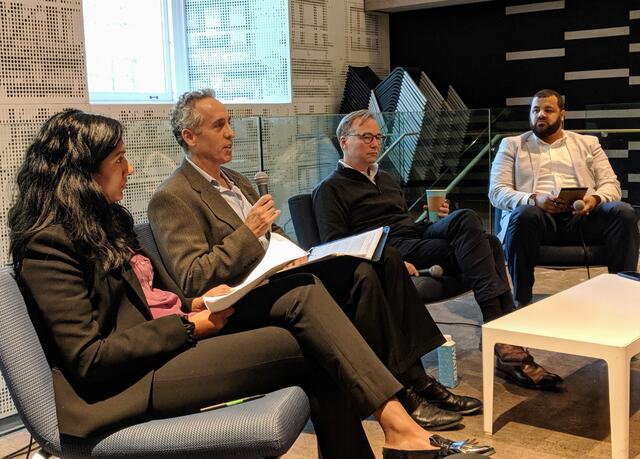
A November 1 panel organized by the Society of Professional Journalists chapter at Columbia Journalism School sought to answer just that, along with how Baghdadi’s death will impact the 2020 presidential election. The participants were Columbia Journalism School dean Steve Coll; Stuart Gottlieb, adjunct professor of international affairs and public policy; and Priyanka Motaparthy, director of the Project on Counterterrorism, Armed Conflict and Human Rights at Columbia Law School.
Coll suggested that ISIS, while physically no longer a geographically-based caliphate, is still strong.
“We have enough experience with not just a post-September 11 landscape of charismatic leaders, network groups like this to understand that they're often quite resilient,” he said. “They have a structure that is much more complicated than the figurehead of even a strong leader might suggest.”
Gottlieb echoed those sentiments, pointing out that the ideology is not new, nor is it easily defeated.
“The fact is, while there's been so many setbacks for the global jihad movement over the years—its ideological power, its sticky recruiting power, its strike capacity occasionally dented—nevertheless, it's going to be with us for some time to come,” Gottlieb said.
Even as ISIS has lost control of key territory to claim itself as a physical caliphate, Motaparthy said, people in fragile states, namely Syria, still fear for their lives.
“What I found was very much a sense that people were so very frightened that they found it very difficult to speak with me about violations ISIS had committed against themselves or their family members because they were fearful of sleeper cells remain in the area,” she said.
Finding the solution for more accountable counterterrorism laws is dependent on the lawmakers who need to be held accountable in every election cycle.
“I think we should always make adjustments,” Gottlieb said. “New people come into Congress, you push back on some aspects of the Patriot Act, some of the harshest torture provisions are sunset, every four years and they have to come back up for reauthorization.”
“So there's always an opportunity for Congress and the American people, through the channel of Congress, to adjust these,” said Gottlieb.
Justice can be a novel concept in a region absent law and order. In her opening remarks, Motaparty said that prescribing punishment at a granular level amongst culpable parties remains indiscriminate in war-torn areas.
“These also become very serious questions for the victims of [ISIS]. One of the big problems with the trials in Iraq is that you had individuals who served as cooks for ISIS as drivers for ISIS getting the same sentence is that individuals were guilty, a very heinous crimes like murder, like mass rapes,” Motaparty said. “They were getting the same sentences.”
In 2012 President Obama used the catchphrase “Osama bin Laden is dead and General Motors is alive.” Asked if President Trump can now say something similar, given the successful military operation and a strong performing economy, Gottlieb and Coll offered differing accounts.
Obama, said Gottlieb, “did have this advantage of incumbency and the image of the bully pulpit to say, ‘I have done these things, I made promises to get out of Iraq, promises to be hard on terrorism, I fulfilled these promises.’ It definitely wasn't negative on his election and might have been a slight positive for 2012. So this foreign policy accomplishment for President Trump is an added benefit in the run-up to the election.”
In contrast, Coll questioned whether repeating the blustery talk of the 2016 campaign would benefit President Trump. “I don't think [saying] ‘I'm going to bomb the crap out of ISIS’ or standing up and saying ‘I killed Baghdadi’ is going to have the resonance that it did in previous eras,” he said.
“I think the country is in a different place. I think these issues resonate in a different way.”
— Daniel E. White MPA ’20, who also moderated the panel discussion.