Image
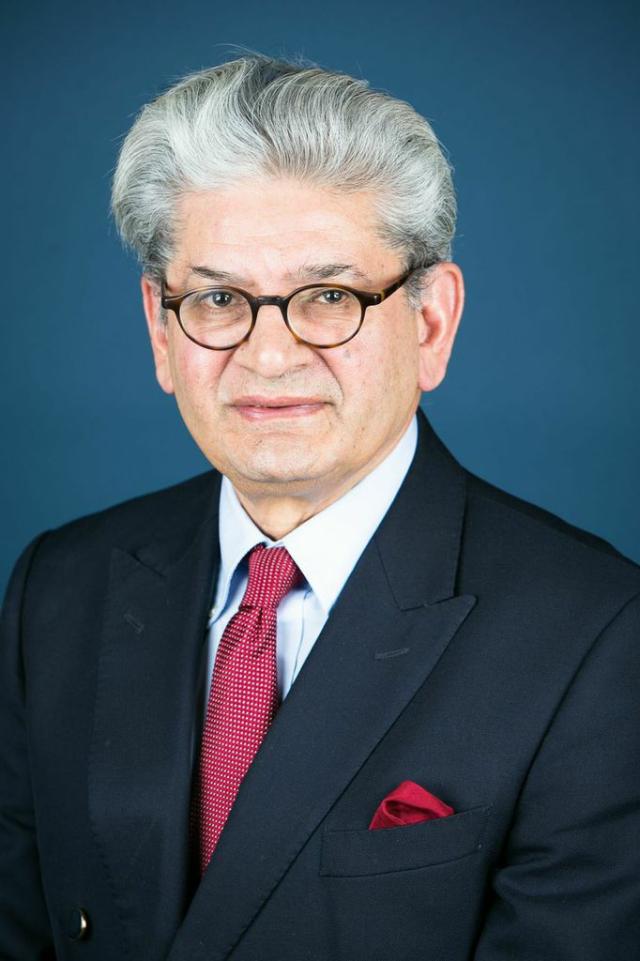
It is with profound sadness that Columbia SIPA announces the passing of its distinguished colleague, Akbar Noman. Akbar was a beloved adjunct faculty member, colleague, and friend whose scholarship and teaching in development economics had global impact. Most importantly, he was a devoted mentor to his students, even after they left Columbia.
He was a senior fellow at Columbia’s Initiative for Policy Dialogue, where he worked closely with its founder Joseph E. Stiglitz. Noman was cochair of the Institute’s Africa Task Force, and adjunct associate professor at Columbia SIPA.
Noman’s career brought him from Pakistan, where he grew up and later served as an economic adviser during the government of Prime Minister Benazir Bhutto; to Oxford University, where he both studied and taught; to the World Bank, where he worked for more than 25 years, focusing on economies in Africa, South Asia, and the former Soviet Union; and finally to SIPA, where he shared his deep commitment and mighty intellect with his legions of students.
“Akbar was a wonderful colleague and collaborator, and a devoted and engaged teacher,” Stiglitz said. “We initially met on my first World Bank trip, to Ethiopia, where he was chief economist, early in 1997. He had a uniquely close relationship with Premier Meles Zenawi, and the three of us worked together from then until Meles’ death in 2012. Akbar brought strong theory from his days at Oxford, together with deep insights into the development process together with a humanity that made his advice compelling. For more than two decades SIPA students were lucky to benefit from such a wise and caring teacher — alas, the only scholar on African economics in our faculty. He helped shape careers and lives. He will be sorely missed.”
Throughout his career, Noman dealt with the questions of dignity and equity in the context of economic growth. He coedited, alongside Stiglitz and others, The Quality of Growth in Africa and Good Growth and Governance in Africa: Rethinking Development Strategies which sought to address the challenges of economic growth in postcolonial societies. His research made the case that growth must be sustainable, with minimal exploitation of both people and the environment.
“He remained a man of the idealistic generation in which he had grown up: Convinced that public life mattered, that developing countries could change their fortunes, and that serious people could make a difference,” Arjun Jayadev, a senior researcher at IPD, wrote in tribute.
“Akbar was a beloved faculty colleague at SIPA, and he continued to mentor many former SIPA students years after they had taken his course on African Economic Development or Comparative Development, or after he had advised their Capstone workshop teams,” Eugenia McGill, senior lecturer and codirector of the Development and Governance concentration at SIPA, said. “He made a point of meeting one-on-one with every student in his classes, and I'm sure many of those conversations were life-changing for the students, and possibly for Akbar as well.”
Noman obtained his undergraduate degree at Oxford University, as well as a master’s degree in economics. He later had academic appointments at Oxford and at the University of Sussex.
“Akbar Noman was an intellectual and teacher who brought to his ideas and commitments in political economy and politics the knowledge acquired not only from a fine academic education but also from wide experience in the field in many parts of the world — South Asia, Africa, England, America, East Asia,” Akeel Bilgrami, a professor at Columbia’s philosophy department, said. “His presence both in the classroom and in the drawing room was one of gentle civility and, above all, a wide humanity.”
“Akbar was an excellent academic and a good friend,” José Antonio Ocampo, professor emeritus of professional practice in international and public affairs, said. “I had the opportunity to teach a course with him on development over several years, and also to write with him some analytical papers. It was always fantastic to work with him. I will miss him greatly.”