Creating your SIPA course schedule
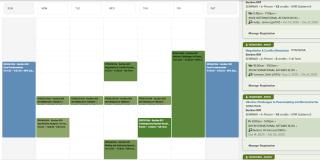
Creating a course schedule is always an important yet exciting step in the life of every seeple. During my time at SIPA, I have spent days, if not weeks, contemplating how to achieve the best schedule possible. In this post, I would like to share my thoughts on courses and scheduling with you, and show you what my SIPA schedule looks like!
Required courses
For most students, especially the first years, required courses are the core of their schedules. There are many types of required courses, depending mostly on what your program and concentration are. For example, as a person with the International Security and Diplomacy (ISD) concentration, I have to take the Foundations of International Security Policy course, which only takes place in the Fall semester. However, most of my general requirements, such as Quantitative Analysis, Leadership in Action, or Economics for International Affairs, could be taken in any of my four semesters at SIPA. That gives me a lot of space to craft my schedule in a way I like. You can see some sample course plans here.
Finding a good balance
Different strokes for different folks. Is it better to “get rid of” all the requirements in the first year, or split them somehow evenly? That really depends on your personal preference, and I can tell you that there are all sorts of strategies implemented by SIPA students. My personal strategy has always been to find a good balance between the types of courses. For example, this term, I have 4 main courses - Quantitative Analysis, Negotiation and Conflict Resolution, Contemporary Russian Security Policy, and Intermediate French I. As you can see, my quant course is the STEM course of my semester, Negotiation and Conflict Resolution is an amazing course to develop soft skills for negotiation, Contemporary Russian Security Policy is more of a research-heavy and field-oriented course, and French is a language course, so different parts of my brain are used there. I find this way of scheduling really helpful not to make my term too STEM-heavy, and to prevent having to do 500 pages of readings a week.
Morning courses?
Not for me! I prefer to spend my mornings doing readings, and working on my assignments, which is why I registered mostly for courses that take place later in the day. Your class might start as early as 8AM, and finish as late as 9pm, in special cases even later than that!
What days?
People sometimes debate whether it is better to have 1-2 classes every day, or put all of them in 2 days or so. This, once again, depends solely on your preferences. For me, having all classes on the same day would be unbearable, which is why I prefer the former model, as shown in the picture below. Full-semester courses would usually carry 3 credits, while half-semester courses would usually have 1.5 credits. In my schedule, Writing and Delivering Speeches only takes place in the second half of the semester, and it carries 1.5 credits.
Weekend classes?
Not very common, but possible! Sometimes, there are short courses, for example 2-week-long ones, where you would have intensive sessions, often during the weekends. In my schedule, you could see that I am taking Excel Fundamentals, which is a special 0-credit course that takes one Saturday and one Sunday. In addition, I am registered for a 1.5-credit course that takes place on two Fridays in October.
Add/drop period
The add/drop period is a time, spanning about two weeks, when students are free to register for courses, and also drop them. This usually happens when you register for a course, attend the first session, but realize that it is not for you. I love this period because it really gives you freedom in deciding what courses you are committed and interested to take. The add/drop period usually takes place at the beginning of each semester.
Cross-registering
SIPA students are able to cross-register for courses at other Columbia schools, such as the Business School, Law School, Journalism School, and many more! It is a great way to go beyond SIPA and see what fields and experiences Columbia has to offer. You can find more information about cross-registering here (select “How to cross-register”).
Course evaluations
To help you with picking the best courses for you, you can use course evaluations, available for all Columbia students at Courseworks. There, you will be able to find detailed annual statistics about all courses offered at SIPA, along with graphs, evaluations, and some student feedback.
Hopefully, this post gave you some more insight into the life of a SIPA student, and helped you get an overview of what scheduling courses here looks like!