Talking with the Enemy
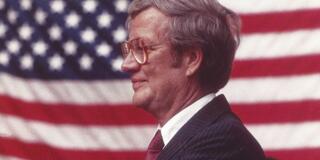
The entire SIPA community wishes a fond farewell to Ambassador William Luers, a renowned adjunct professor at Columbia for the past decade, who is retiring following an illustrious career spanning nearly 70 years.
Luers’s first experience with SIPA began in 1957, when he started his graduate studies following an undergraduate education at Hamilton College and a five-year stint serving as an officer in the US Navy. At SIPA he launched his career as an internationalist, taking his first course on international affairs at age 27.
“SIPA is where I learned about the world and began my professional life; Columbia’s Russian Institute and School of International Affairs launched my career,” Luers says. “My admiration for the many professors who nurtured this complete neophyte has stuck with me.”
After graduating from SIPA, Luers took his knowledge of and queries about the challenges of diplomacy and began what would become a 31-year career in foreign service. He served as US ambassador to both Czechoslovakia and Venezuela and held various posts in Italy, Germany, and the Soviet Union. At the Department of State, he was deputy assistant secretary of state for Europe and for inter-American affairs. In 1986 he was named president of the Metropolitan Museum of Art; he held that position in New York City for 13 years. He then became president of the United Nations Association of the USA in 1999 and held that position for 10 years.
Staying Connected through the Classroom
Luers’s career with the US government was remarkable, in part, because of his experiences with the important historical figures he worked with and befriended—from smoking cigars with the Cuban deputy foreign minister, Pelegrin Torras, after negotiating an agreement in 1977 on opening a US Interests Section in Havana to giving neckties to Václav Havel on the eve of his inauguration as the first president of the free Czechoslovakia after the fall of communism.
During his time in the US Foreign Service, Luers also began his teaching career as a visiting lecturer at the Woodrow Wilson School at Princeton University (now the Princeton School of Public and International Affairs), George Washington University in Washington, DC, and the School of Advanced International Studies (SAIS) at Johns Hopkins University.
“Teaching regularly has been life enhancing for me since I first started as an adjunct teaching a course on the Soviet political system at SAIS in Washington in the 1960s,” Luers says. “Nothing has kept me better connected than those teaching and learning experiences.”
The course he taught at SIPA was Talking with the Enemy, which was based on his extensive professional experience as a Foreign Service officer (FSO). Luers used real-world case stud- ies of past US presidents and their relationships with adversary states and leaders — important political conflicts that, in many cases, he had experienced directly, such as the thaw in US-Soviet relations during the 1960s.
“Diplomacy is primarily about finding ways to work with people you disagree with,” Luers says. “You have to learn as much as you can about their weaknesses, strengths, and moti- vations so you can develop a strategy for reducing conflict. You want to make your adversary feel like they’re getting what they want — without sacrificing what you want. I’ve applied that to diplomacy in my own life, and I tried to bring those experiences into class.”
Nancy Talamante MIA ’20, a Thomas R. Pickering Foreign Affairs Fellow at SIPA and now an FSO, took Talking with the Enemy in spring 2019 as part of her journey to joining the Foreign Service.
“Ambassador Luers really created an experiential-learning environment, using lots of role play and debates around decisions that presidents like Nixon and Kennedy made and whether we would enter into conflict or diplomacy in the same situation,” Talamante says. “He had met a lot of the key players in the case studies we examined and could tell us more about them as people, which helped us understand their decision-making process. Talking with the Enemy was one of the most engaging and interactive classes I’ve taken in my entire education.”
Luers invited Talamante to be his teaching assistant for the course in spring 2020, which would turn out to be his final semester teaching the class. “Ambassador Luers innovated the class according to present-day issues — it wasn’t a one-size-fits- all approach,” says Talamante, who is going to Malaysia for her first tour as an FSO this fall. “As a first-generation student of color, I considered him an important mentor for me and very accessible to all of his students. He offered us such a wealth of experience and knowledge.”
Deep Gratitude for William Luers
SIPA students and alumni have certainly appreciated Luers for all of his knowledge, counsel, and hard work. Besides Talamante, a number of his former students are working in impactful careers around the world, including Laura Daniels MPA ’15, an FSO in conflict and stabilization operations in Europe, and Myrian Smith MIA ’18, a surface warfare officer in the US Navy.
Beyond the student community, SIPA faculty, staff, and administrators also recognize Luers’s contributions to the School’s reputation for teaching and learning dedicated to making a difference in the world.
“I thank Bill and applaud him for his years of teaching at SIPA and his incredible contributions to foreign policy,” Dean Merit E. Janow says. “I am grateful to know him as a person and am deeply appreciative of his expertise and commitment to SIPA.”
With his retirement at 92 years old, Luers will now focus on writing a book summarizing his career experiences and outlook on diplomacy. He is also the director of the Iran Project, which has been conducting Track II, or back-channel, diplomatic efforts for 20 years to improve official communications between Iran and the United States. Luers says he also looks forward to spending time with his wife, Wendy Woods Luers, founder and president of the Foundation for Civil Society, as well as his 3 children, 2 stepchildren, and 10 grandchildren.
This story appears in the most recent issue of SIPA Magazine, published in October 2021.