Image
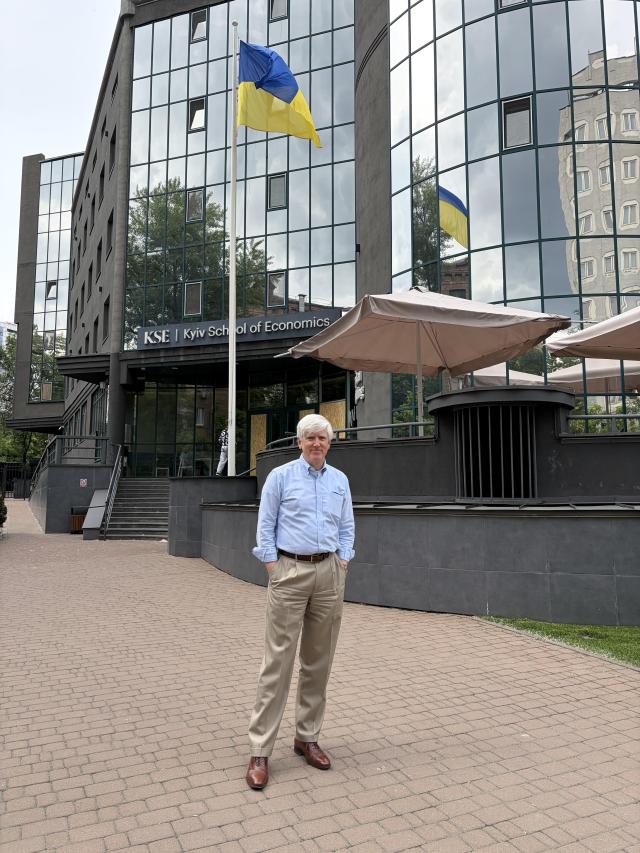
On most nights he spent in Kyiv over the summer, Columbia SIPA Professor Stephen Biddle was shaken out of bed by Luke Skywalker. The Star Wars actor Mark Hamill delivers the English voiceover of an air-raid app advising users to seek shelter whenever a drone or missile is in the vicinity.
Biddle was in Kyiv to teach a course on security policy at the Kyiv School of Economics. Bound by promises he had made to his family, he got out of bed every time Mark Hamill commanded, and went down to the “shelter” — a parking garage beneath his hotel. Usually, he found it completely empty. Four years into the war, Kyivans are choosier with their air-raid behaviors. When an alert sounds, they typically open Telegram to see what’s reportedly in the air and if it’s just drones, most of them just carried on with their lives.
Biddle said Ukraine did not feel like other war zones he’d visited.
“Unlike Baghdad or Kabul, you could walk around Kyiv, and if you didn't know there was a war going on, you wouldn't necessarily know it if there wasn't an air raid going on at the time,” he said. “Most buildings are intact. The restaurants are full. Coffee shops are everywhere and busy. There's traffic on the streets. People are out and around. It's surprisingly normal looking.”
“Now, when you go a little below the surface, much less so,” Biddle added. “So if you look, there's plenty of damage and you can see it. But it's not like Sarajevo. It's not like Kherson (a port city in southern Ukraine) or other cities that are within artillery range and drone range of the front lines and are devastated.”
One evening, he was joined by a curious Ukrainian passing by the garage. With the help of a translator app, Biddle introduced himself as an American professor teaching a course. The man turned out to be an air defense officer in the Armed Forces of Ukraine, and the two of them ended up having an hour-long conversation via translator apps. At some point, the officer opened Delta, the Ukrainian military’s battlefield management and situational-awareness system on his phone, and showed Biddle what the night’s sky looked like from the defenders’ perspective. On the screen, Biddle saw a pair of Ukrainian helicopters hunting a Shahed drone somewhere nearby, in real time.
Biddle has spent 40 years studying how wars are fought. He has been in war zones before, mostly in Iraq and Afghanistan, and he knows what an American information system looks like. “An information system like that in the US would be so secure and so tightly controlled that no one would be able to use it. In Ukraine, fairly random Air Force officers have it on their phone and are willing to show it to a visiting American.”
The sheer ubiquity of such information, according to Biddle, is part of what’s enabled Ukraine to get high shoot-down rates — high enough that many Kyivans choose not to worry as much about a few propeller-driven drones in the sky anyway. The Ukrainians, he added, are “really good at fusing different intelligence streams into a common operating picture. Way better than we are.”
“Way better than we are” — that phrase comes close to summarizing the research that brought Biddle back to Kyiv in August, and an argument that he hopes will eventually reshape how the United States treats military aid to its allies.
Engineers solving a political scientist's problem
In the summer of 2023, newly raised Ukrainian brigades went on a promising offensive with new, advanced Western armor — Abrams and Leopard 2 tanks sent by the United States, Germany, and other allies. But while in Western practice, a tank survives only inside a team of infantry, artillery, engineers, close air support, and air defense — formed of officers trained for 10 to 20 years to run exactly that kind of formation — the new Ukrainian brigade had nothing like that backing them up. They ended up using the tanks in ways the US Army would have thought unlikely to succeed. Succeed they did not.
The Americans, who provided the tanks, were unsurprised. US security assistance overall — a trade term for what the United States does when it arms and trains another state’s military — has a gloomy track record. The cases that shaped the field are Vietnam, Iraq, and Afghanistan, where the recipients’ performance, in Biddle’s words, “was very disappointing”.
“We provide a lot of stuff,” he said. “It often doesn’t have as much of an effect on the recipient’s military capabilities as we expect and hope.”
According to the SIPA professor, in Vietnam, Iraq, and Afghanistan, the provider and the recipient wanted different things from the military aid. Washington wanted the war won and didn’t care much about who’s left to govern. Meanwhile, the governments it was arming cared most about staying in office and used what aid they got accordingly. In wars like these, American doctrine ignored this problem to its detriment.
Biddle explains that part of the reason why American doctrine has overlooked this misalignment of interests is that the people who write the doctrine “tend to view security assistance as an engineering problem and not a political science problem.” The Americans identify partner shortfalls in weapons, equipment, roads, hospitals, and schools. In US doctrine, the American role is then simply to provide the missing stuff. And the assumption has always been that the American providers know best what stuff the recipient needs, and how it should be used.
But Ukraine, according to Biddle, breaks the model.
Not only do the Ukrainians regard the war as an existential threat and thus have a much closer motive to Washington than the United States’ other partners, but the expertise asymmetry today is also on Ukraine’s side, with NATO and American units consistently taking heavy losses when training against Ukrainian drone teams.
In the craft of keeping infantry alive under drones, which means cover, concealment, electronic warfare, and hunting the other side’s drone crews, Western armies, according to Biddle, are falling behind. The Ukrainians are substantially more sophisticated than whatever the US Army is capable of implementing. What bothers him is how little the US has done to catch up.
“The US has surprisingly little fact-finding activity on the ground in Ukraine. Very few American military officers are observing what's going on. There's no systematic effort to harvest lessons from Ukrainian experience and use it to improve US military doctrine,” Biddle said. The teacher never expected to be learning from the student, so the mechanisms to do so were never built.
The study that seeks to change that — and the very thing that brought Biddle back to Kyiv for the second time this summer — is led by Bob Hamilton, a former US Army colonel and Biddle’s colleague from the US Army War College, and funded by a grant from the Defense Security Cooperation University.
He expects the report draft to be ready by this winter or spring and can already describe what a revised US security assistance doctrine would ask for. American military personnel would go forward with the military equipment to train the recipient how to use it, but more so to learn — watch what the recipient does with it and carry the lessons back to the States. The money might move differently, too — instead of offering allies whatever has already come out of the “long, elaborate, formalized American procurement system,” American firms could design equipment alongside the units that will use it.
As an example, Biddle refers to the Hornet, a long-range autonomous drone that Ukrainian brigades used this summer in a campaign against Russian logistics. It was designed jointly by American defense technology company Perennial Autonomy and the brigades that ended up flying it, with company representatives sent forward into Ukraine.
Still, Biddle does not expect the study’s results to apply to Ukraine. In fact, because the US is scarcely providing any assistance to Ukraine anymore, Biddle is skeptical that much will change on that front. “But military doctrine is written for future wars,” he pointed out.
Learning from the past
Biddle has followed the war in Ukraine as closely as he can for years. Being there “made it personal in a variety of ways,” he said, but the trip “tended to extend rather than simply reverse or overturn things that I thought I understood.”
The largest of those is quite unfashionable. Unlike the “drone revolution crowd,” Biddle does not believe that drones and satellite surveillance have produced a military revolution that hands the advantage permanently to the defender. The problem of “million-dollar missiles shooting down thousand-dollar drones” exists, he said, because those missiles were designed to shoot down $50-million airplanes. Cheaper air defenses are catching up with cheaper aircraft, and the experts he interviewed on the ground tended to “not disagree” with Biddle’s position.
The professor believes that the best analogy for Ukraine right now is Europe circa 1917 — before the trench stalemate was eventually broken. “People right now observe that it’s 1917, and they’re projecting that forward as the future wears on. If you’d done that in 1917, you’d be radically wrong, and the French did,” he said, referencing the Maginot Line that was later built on the expectation that trench warfare was permanent.
Some combination of interceptor drones, attacks on drone operators, and strikes on the supply of new drones will bring back the ability to maneuver again, probably before this war ends, predicts Biddle. But most people in the debate over the future of warfare don't think much about wars other than the one they are writing about, “so there’s a role for folk like me to smack them around a little and say, ‘No, you need to pay attention’.”
None of this, however, understates what the stalemate costs in the meantime. The infantry on what Ukrainians call the “zero line,” or the “kill zone,” the positions closest to the Russians, are hard to rotate because any movement is easily detected. Some of the infantrymen spent close to a year in a hole in the ground, said Biddle, unable to leave unless the weather eases the drone threat. “Their circumstances are as awful as anything I’ve heard about in military experience going back to the First World War.”
As for his SIPA classroom in New York, the summer mostly confirmed what he was already doing. “I try very hard to convey to students that this is a mission. This isn’t just a job. This stuff matters,” he said. “We have an obligation to the public interest, and we should try to fulfill it. We’re not selling sugar water here.”
Teaching in a bomb shelter
Before returning to Ukraine for research, Biddle made his first-ever trip to the country this summer to teach. The Kyiv School of Economics is starting a master’s program in security policy and has been building ties to Western universities. What came out of it was a short version of Foundations of International Security Policy, a course every International Security and Diplomacy concentration student is familiar with, taught by Biddle and three faculty colleagues at SIPA.
“Short” undersells it. The class met for two hours every evening for two weeks, since many students worked during the day. The course had a long waitlist, with folks from Ukraine’s Ministry of Defense, and many of the country’s think tanks often joining as auditors. They were, according to Biddle, “the most engaged student population I’ve taught on any subject anywhere.”
The glass in the school’s doorway had been blown out shortly before he arrived, and every classroom was paired with an assigned room in an underground bomb shelter. If Mark Hamill ever came on during class, Biddle said, “you just unplug the laptop, carry it down to the bomb shelter with students all walking down with you, plug it in there, and carry on. The School’s bomb shelters were all wired for PowerPoint.”
Teaching in an underground bomb shelter was a first. So were two moments in the course that went very differently than they ever have in Morningside Heights.
The first concerned just war theory and the principle known as the moral equality of soldiers — since governments, not soldiers, make the decisions on war and peace, so long as the soldier fights within the rules, the principle holds; he is not answerable for the injustice of the war itself. Hands went up as soon as he laid this out, Biddle remembers. The Russians in Ukraine did make this decision, the students told him. They are all volunteers, which makes them all war criminals. He doubts the students ever heard the principle before or had a prior opinion about it, but “when they heard it, they said, ‘That isn’t right.’”
The second tension came from the unit on defense budgeting — every country has to decide how much of its “butter” — the civilian economy — to sacrifice on “guns” — military capability. A subset of students argued that in Ukraine, “there is no butter, it’s all guns.” That cannot possibly be true, Biddle objected. If it were, the civilian health system would’ve disappeared, everyone would’ve starved two years ago, and the cars driving on Beresteiskyi Avenue outside the school would have all run out of gasoline. That, the students argued, is all aid from the Europeans; every hryvnia goes to defense. Money is, of course, fungible, but a lot of the students weren’t having that.
“I don’t think it’s random that they had these reactions,” Biddle said. “It’s a clear response to their circumstances.”
At the end of the course, he told his students “Slava Ukraini” and received a thundering “Heroiam slava” from the whole class.
“I think it made a difference to them that somebody from Columbia University would come all this way,” he said. “I was grateful for the opportunity, in part because I thought it was making a difference in a different sort of way than one makes a difference here.”
When he wasn’t teaching, Biddle would lose himself in the streets of Kyiv, which had been rid of all street signs in February 2022, leaving taxi drivers “completely screwed” with no way to orient themselves every time the GPS was down as a result of an air raid. He marveled at the incredibly deep and ornate metro stations that doubled as bomb shelters and, to add to his collection of antique recruitment posters at home, took pictures of the unique recruitment posters, which in Ukraine are put up by individual units, not the army as a whole.
Most of all, though, he was surprised by a tourism sign he kept seeing all over the city. “Kyiv is waiting for you after the victory,” it said. Not after the war, after the victory. And the poster was in English, so who was it meant for, exactly?
“I wouldn't have guessed that there's a big tourism market in Kyiv right now. Call me crazy, but it takes three days to get there, and the hotels all advertised their bomb shelters as amenities,” said Biddle. “So, I'm not sure who that was aimed at exactly. It worked for me, I suppose.”
Still, with US security assistance all but gone and interceptor missiles depleting, the future looks grim. By the end of his trip, in late August, Biddle witnessed how, in place of a raid or two a night, Russians began launching one every hour or two, day and night, with ballistic missiles mixed in at random. Newer drones are now targeting food supply and transportation, since they can now be controlled via camera on the nose, making them capable of hitting moving objects.
The shelters that were empty at the beginning of his trip were now more often filled before air alarms even rang, with people sitting shoulder to shoulder.