Image
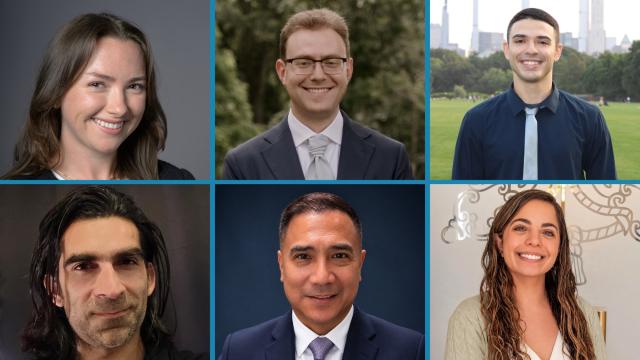
Six first-year SIPA students have been awarded the school’s new Public Service Scholarship, a program that both recognizes students’ previous service and encourages future careers in public service. Among this year’s cohort of awardees are a former United Nations speechwriter, a native New Yorker using data to inform government programs, and a sergeant major in the US Army Reserve.
Fernando Medina MPA ’28, one of this year’s awardees and a born-and-raised New Yorker, plans to use his expertise in program evaluation and interest in data science to improve government policy.
“I really felt growing up that it was important that the government try to ensure equality of opportunity,” he said. “You know, make sure that everyone has a real chance to succeed.”
Public Service Scholars commit to pursuing careers in public service after graduation, which Medina hopes to do in his hometown of New York City.
“I would love to use some of the data skills that I’m gathering within the program to be a data analyst at a government agency,” Medina said. “Honestly, I’d love to stay in the city that I’ve grown up in and that I love, and really help make it a better place.”
To qualify for the scholarship, applicants must have at least three years of professional experience in public service jobs. That could mean working in government, serving in the military, doing nonprofit work, or participating in national service programs like the Peace Corps or AmeriCorps.
Samrat Pathania MPA-ESP ’27 started his career as a software programmer but switched to climate education with “the awareness that public understanding of science is a cornerstone of a robust democracy — and public education is the correct means to work on it,” he told SIPA News. “This change of careers has unequivocally been one of the best decisions of my life.” For more than a decade, Pathania has worked with New York State initiatives and nonprofits to teach K–12 educators and communities about climate solutions and decarbonization practices.
“The obvious next step for me was to grow my understanding of the formulation of public policy and how it shapes and is shaped by public opinion,” he said. “That’s what brought me to the MPA-ESP program at SIPA.”
The scholarship covers up to 65 percent of tuition and provides opportunities to work with eminent scholars and policy practitioners.
Scholar Grace Cusack MIA ’28 has worked for both the US State Department and the United Nations. Her work has focused on advancing women’s rights and gender policy with UN member states, working on budgetary and finance issues, and crafting speeches for the president of the UN General Assembly.
“I’ve always been interested in the intersection of international security and human rights,” Cusack said. “At SIPA, I really want to think about how the protection and promotion of human rights can really be used in conflict prevention and conflict resolution.” That, she hopes, will lead to “better diplomacy and mediation strategies by putting human rights at the center, [and] will ultimately create a more durable and lasting peace in societies.”
Sgt. Maj. John Smits MPA-GL ’27 joined the Army at age nineteen and spent ten years on active duty, serving in Iraq and Afghanistan. Now in the Army Reserve, Smits is a student in the MPA in Global Leadership program.
“Policy, especially for service members, has a real and lasting impact,” Smits said. “When it comes to policy decisions that involve sending troops into harm’s way — those are very important to soldiers, service members, and their families.”
David Kahan MIA ’28 is an active duty Army captain and father to a six-month-old. In his eight years of military service, he’s deployed once to Afghanistan and twice to Italy, and he has been responsible for units as large as fifty soldiers. He’ll continue his military career after leaving Columbia.
“After graduation I will attend the Army’s course for strategists — the Basic Strategic Arts Program at the Army War College — prior to starting my first assignment as an Army strategist,” he said.
Preparing SIPA students for careers in public service is critical to the school’s mission — especially in a world rife with inequality, conflict, and institutional mistrust.
Serena Viti MIA ’29, a dual-degree student pursuing an MIA at SIPA and an MSSW at the Columbia School of Social Work, came to New York after working with the Holy See at the Vatican. “I’ve worked in social and economic policy for their Office for Human Development, and now I’m working on research and policy for the Office of Child Protection,” she said.
After completing her degrees, Viti hopes to work on “restor[ing] trust in institutions, helping to really foster those concrete values that I’ve been working on with the church, like human dignity, common good, [and] solidarity,” both internationally and at the local level, she said. “That’s why I’m pursuing my degree in social work — I want to stay connected to local communities and advocate on their behalf and bring that to a larger policy level and scale.”
These scholars have already spent years — or entire careers — pursuing the public good, but their commitment to further service puts them in a position to shape what comes next.
“We still have more to contribute and more to give,” Smits said. “And while our service shaped who we are, it shouldn’t be the limitation of what we can be.”