Pragmatic Engagement with Afghanistan: Can the International Community Promote Human Rights?
Since the fall of the Afghan republic two years ago, a dramatic transformation has swept across the nation of Afghanistan. The Taliban has firmly cemented its grip on power, extending its influence into every corner of Afghan life: political, economic, and social.
Looming over this new reality is the tenuous relationship between the Taliban and the international community, as each side struggles to understand its ability to sway the other. Both cautiously await signs of a retreat from their opposing positions.
Caught in the crossfire are the Afghan people themselves, especially women and minority populations — vulnerable groups whose rights and freedoms hang in the balance as the two sides engage in a tense standoff.
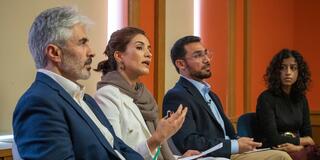
At a September 22 panel discussion hosted by the Saltzman Institute of War and Peace Studies, panelists examined the heart of the Taliban's decision-making environment. Among other things they worked to identify mechanisms that will encourage the Taliban to take positive steps toward safeguarding the rights of women, children, and minorities.
Participating experts
- Aref Dostyar, Senior Advisor for the Afghanistan Program for Peace and Development (AfPAD) at the University of Notre Dame’s Kroc Institute for International Peace Studies
- Sibghatullah Ghaznawi, Associate Research Scholar, SIWPS; Former Deputy Minister of Municipal Affairs, Government of the Islamic Republic of Afghanistan
- Hosna Jalil, Former Deputy Minister of Interior, Government of the Islamic Republic of Afghanistan
- Dipali Mukhopadhyay (moderator), SIWPS Affiliate; Senior Expert on the Afghanistan Peace Process at the United States Institute of Peace; Associate Professor, University of Minnesota
Selected insights
“In the engagement, we have to get out of a binary thinking…. We need to also move from a Taliban-only to an Afghanistan-inclusive approach, because this is a country that belongs to 40 million people, not 70,000 fighters of the Taliban. I agree we don’t know a lot, but we are also in contact with our families, with our friends on the ground, and the Taliban do not have popular support. We have to amplify narratives that are helpful for Afghanistan.”
— Aref Dostyar
“We did not perceive the invasion of 2001 as a saving mission of Afghan women…. From an Afghan’s perspective, I don’t think that any Afghan woman believed that the Americans were here for us…. We need to give [women] the space, and they are trying to find their ways to express themselves, either through social media, through anything that the Taliban cannot control as much as they control the mass media. Their priorities are very realistic, very practical… They are focusing on the core, and we are focusing on the edges here, sitting in the West…. What the women in Afghanistan are saying, that should be at the forefront of everything.”
— Hosna Jalil
“This environment for policymaking that is emerging and getting consolidated day by day, it is very interesting, but it is not rocket science; it is workable…. What I am proposing is that we should start understanding the system in a proper assessment, before that window is closed…. Before that happens, we need to study their policy making environment…. These are the things that we need to study, and study is possible…. Let us study their policy environment, how it is made, what pieces of knowledge they use, what is the logic, and how they make rationalizations for political policy decisions.”
— Sibghatullah Ghaznawi
Watch the complete event: