Monetary Policy Challenges in Asia Pacific—A Panel Discussion with Asia-Pacific Central Bank Governors
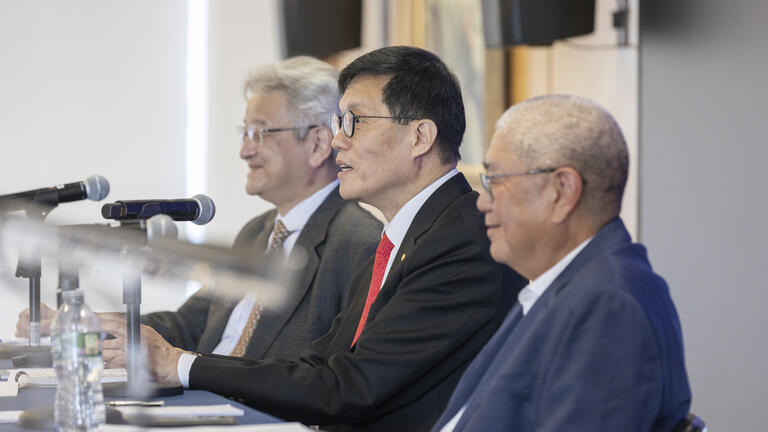
On October 22, 2024, Columbia University hosted a panel discussion featuring Governor Eli Remolona, Bangko Sentral ng Philipinas and Governor Rhee Changyong, Bank of Korea. The discussion, moderated by Professor Takatoshi Ito, focused on Asia’s muted inflation experience post COVID.
Post-COVID Economic Dynamics in Asia
The panelists noted that, following the COVID-19 pandemic, Asia experienced supply shocks, energy price volatility, and broader global inflationary pressures. However, the impact in Asia was more subdued compared to US and Europe, where inflation peaked sharply in 2022, partly due to its proximity to global supply chains, more controlled fiscal measures, and different labor market dynamics. Asian central banks managed to stabilize inflation rates differently in response to circumstances of each country.
Balancing Multiple Mandates
The discussion addressed the challenge of balancing multiple mandates, such as inflation control, financial stability, GDP growth, employment, and exchange rate stability. While price stability remains the primary objective, panelists emphasized the need to consider financial stability risks when setting monetary policy. Further, the panel noted that exchange rate fluctuations have a significant impact on inflation, particularly in economies with high trade dependencies. The discussion underscored the need for central bank independence.
Inflation Target Expression
The debate over the most effective form of inflation target expression—point target, range, or level with a tolerance band—was central to the discussion. Benefits for a single-level target to improve communication and a tolerance band in reducing volatility were discussed. The panel argued that clearer communication of policy intentions and forward guidance can enhance credibility and manage market expectations more effectively.