Image
As cities across the country confront rising housing costs and uncertain federal support for homelessness services, the mayor of San Diego Mayor is urging other municipal leaders to rethink how they use the tools of city government to address a crisis whose causes and solutions often extend beyond their control.
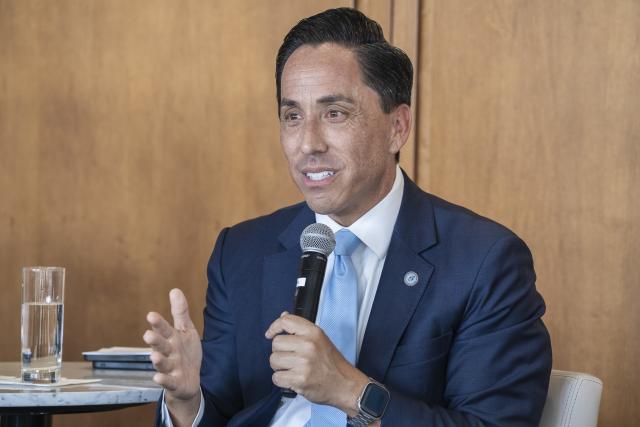
Todd Gloria outlined his approach in San Diego during a September 21 talk at Columbia SIPA with Professor William Eimicke, where he argued that cities can make meaningful progress even when responsibility for housing, homelessness, and mental health and addiction treatment is divided among local, state, and federal governments.
Gloria, who serves as president of the US Conference of Mayors, hopes San Diego can serve as a model for how cities can develop new approaches to tackling housing shortages and homelessness. Since taking office in 2020, his administration has expanded the city’s shelter and outreach system, launched initiatives like the Safe Sleeping Program, imposed aggressive deadlines for affordable-housing approvals, and pushed to revise zoning rules to allow more homes to be built.
“The housing and homelessness crises are national issues, and we need to get more cities in the fight,” Gloria said. “There are a lot of mayors trying to lead on this, and those that are willing to change their policies, build more housing, and find better ways to keep people housed should have the resources to do more.”
Unsheltered homelessness in San Diego decreased by 6.6 percent over the past year, according to the Regional Task Force on Homelessness, falling from 3,354 to 3,132 people and marking the second consecutive year of declines. At the same time, total homelessness, which includes people living in shelters, increased 1.6 percent from 5,866 to 5,958 people – driven by a rise in people accessing emergency shelter services.
The city has added hundreds of shelter beds since the pandemic, and introduced alternatives for people experiencing homelessness who are unwilling or unable to enter traditional shelters. The Safe Sleeping Program, started in 2023, offers secure sites where people can sleep in tents or their vehicles and access support services. The city has also invested in programs designed to prevent people from becoming homeless in the first place, including a shallow rental subsidy program for seniors at risk of losing their housing. Those interventions, Gloria said, can be more effective and less expensive than waiting until someone is already living on the street.
Gloria has pushed to make it faster and easier to build housing. While San Diego’s population has nearly doubled in the past 50 years, from roughly 750,000 in 1976 to 1.4 million today, housing production has fallen sharply. The city built about 15,000 homes a year in 1976, Gloria noted, compared to fewer than 4,000 annually in recent years. “You double your population, but reduce your housing production by two-thirds,” he said, “you have a perfect recipe for a housing affordability crisis, but also a homeless crisis.”
In 2023, Gloria signed an executive order to speed up affordable housing permits, requiring city staff to review 100 percent affordable and emergency shelter projects within 30 days. Projects are now being approved in an average of nine days, he said. The city has averaged about 8,700 housing permits annually over the past three years, more than twice its average over the previous two decades.
Gloria acknowledged the limits of what housing policy alone can accomplish. People dealing with severe mental illness or addiction may need treatment and other forms of support that a city does not directly control. In California, county governments oversee much of the public mental health system, leaving mayors responsible for a problem over which they have limited authority.
As president of the US Conference of Mayors, Gloria has pushed for greater federal investment to give cities the resources to experiment with approaches that increase housing production and prevent homelessness.
The need for that kind of experimentation comes as mayors across the country confront the same pressures. In a recent survey of mayors, 93 percent said the cost of living in their cities had worsened in the past year, with 96 percent citing housing costs as the primary affordability concern. Seventy-one percent said rising housing costs were also making it harder to reduce homelessness.