Image
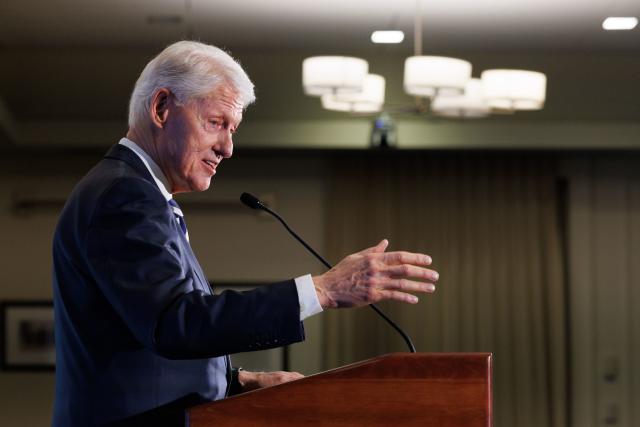
Thirty years after the assassination of Israeli Prime Minister Yitzhak Rabin, Columbia SIPA’s Institute of Global Politics (IGP), together with the University’s Kraft Center for Jewish Student Life, Columbia/Barnard Hillel, convened a gathering of leaders, diplomats, scholars, and students to reflect on Rabin’s legacy and the challenges of the pursuit of peace in the Middle East. The event, featuring formal remarks by President Bill Clinton and a panel discussion with Secretary Hillary Rodham Clinton, Secretary Jacob J. Lew, Ambassador Dennis Ross, and journalist Nadav Eyal — moderated by SIPA Dean Keren Yarhi-Milo — explored Rabin’s psychology as a leader willing to make peace, the impact of his assassination on Israeli society, and the legacy of his death three decades later.
Columbia University’s Acting President Claire Shipman, a former journalist who covered the Oslo negotiations, opened the program by recalling the “feelings of hope and promise” that accompanied the Oslo years, as well as the grief that followed Rabin’s assassination — “a moment that seemed to unite leaders … not only in grief, but in resolve.” Dean Yarhi-Milo followed with a deeply personal tribute. Growing up in Israel, she remembered watching the 1993 White House handshake between Rabin and Palestine Liberation Organization leader Yasser Arafat as “the world was holding its breath,” and later, the night of the assassination, when “the shock was indescribable.” Rabin’s message, she said, endures as a reminder that “peace is not a naive hope. It is a moral and strategic necessity.” She added that Rabin’s death exposed “how dangerous it is when disagreement turns into demonization — when words become weapons.”
President Clinton delivered a moving and at times emotional keynote, offering both sweeping historical analysis and deeply personal memories of his friend. He described Rabin as “a brave soldier, a great military leader, a principled patriot … and a keen judge of how people thought and felt.” Recounting the hours surrounding Rabin’s assassination, he recalled standing alone on the South Lawn of the White House, waiting for news: “I looked up … and I could tell by the look on [National Security Advisor] Tony Lake’s face … that Yitzhak was dead.”
Clinton spoke at length about Rabin’s strategic reasoning in pursuing the Oslo Peace accords. Rabin believed, Clinton said, that “holding on to this land we have occupied since ’67 is not making our security stronger,” and that without a political settlement Israel would eventually face an impossible choice: “If we don’t let [Palestinians] vote … we will no longer be a democracy; if we do … we won’t be a Jewish state.” Rabin, Clinton noted, said he was determined “to make certain that my successors [shouldn’t] have to face that choice.”
In one of the speech’s most memorable moments, President Clinton recounted how Arafat once told him privately, regarding Rabin, that “his word is worth more than any written contract.” That trust, Clinton argued, is the foundation on which peace could have been built: “That’s why I believe had Yitzhak Rabin lived, we would have reached a comprehensive agreement … within two or three years, and the whole world would be a very different place.”
Looking ahead, Clinton urged the audience to “begin again,” invoking Rabin’s credo: “We will fight terror as if there were no negotiations. We will negotiate as if there was no terror.” And he closed as he had at Rabin’s funeral in 1995: with the words Shalom, Haver — “Goodbye, friend.”
The panel discussion began with a reflection by Secretary Clinton on the shift in regional politics since the Oslo years. Despite the horrors of recent years, she urged the audience not to dismiss the possibility of progress: “Maybe this is a new moment of hope and possibility.” Yet today’s leaders face challenges Rabin did not, she added, including the distorting pressures of social media: “Many leaders are not emotionally literate … and he didn’t have to contend with the 24/7 ecosystem that exists today.”
Ambassador Ross, who worked closely with Rabin, described him as “the most analytical leader I ever dealt with” —someone both stubborn and intellectually honest. Rabin recognized that the first Intifada showed there was “no military answer” and that the First Gulf War had weakened rejectionist forces, opening a window for diplomacy. Rabin’s guiding principle, Ross said, was responsibility: “He defined his role in terms of, ‘I’m here so my successors don’t have to make these decisions.’”
Secretary Lew emphasized how Rabin read the political timing of the moment with unusual clarity: “If he didn’t use that moment, the opportunity might not come again.” Even now, Lew suggested, the upheavals of the last two years might create a moment “when something good could be salvaged — but only if leaders step up and seize the moment.”
Nadav, an award-winning Israeli journalist, commentator, and author of Revolt: The Worldwide Uprising Against Globalization, offered a sobering reflection on the world Rabin inhabited versus the present: “Rabin’s era… doesn’t exist anymore,” he said. Yet Rabin’s belief that peace was “not impossible [but] inevitable” still resonates. One of Oslo’s enduring lessons, Nadav argued, was the failure to understand violent fundamentalism as a strategic, not merely tactical, threat: “This was the major strategic threat for any shared existence.”
Still, he said, Rabin’s example endures in Israeli civic memory: “As President Clinton just said, his word was his honor,” Nadav added. “And this lives on within Israeli society and within the narratives of Israeli society. And the fact that his memory lives and the fact that we're discussing this today, 30 years later, means that we can also reassemble ourselves within Israeli society as to [Rabin’s image].”
The evening closed with remarks from Brian Cohen, the Lavine Family executive director of the Kraft Center for Jewish Student Life, Columbia/Barnard Hillel, who recalled being 17 the night Rabin was killed, and how President Clinton’s use of the words Shalom, Haver gave language to a grief felt around the world. Rabin’s legacy, Cohen said, “continues to challenge and inspire” all who believe that “courage and compromise can coexist.”
The audience rose for a final ovation welcoming President Clinton and Acting President Shipman back to the stage, marking the end of a program that stood as a testament not only to Rabin’s memory but also to the ongoing intellectual and moral work required to imagine a better future — one grounded in realism, courage, and the persistent belief, as Rabin himself practiced, that peace is always worth pursuing.