Image
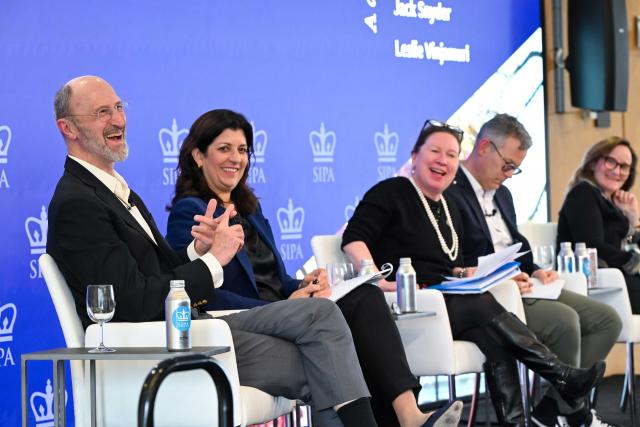
On March 27, the Saltzman Institute of War and Peace Studies hosted the fourth installment of what’s colloquially become known as the “Jervis Conference”: an annual series that memorializes the late Columbia University political scientist Robert Jervis. This year’s conference honored the scholarship and mentorship of Jack Snyder, bringing together dozens of former students of Snyder’s to discuss and debate the future of liberalism in the global order, as well as to challenge several of his key insights. Snyder is the Robert and Renée Belfer Professor of International Relations in Columbia’s Department of Political Science.
According to Ronald Krebs, a professor at the University of Minnesota, Snyder “has championed liberalism's virtues as a corrective to authoritarian vices, but he's also been a critic of liberal ideology when uninformed by pragmatic considerations.”
Many of Snyder’s former students examined the scope of their mentor’s work across multiple themes, including human rights, great power politics, and liberalism’s role in an evolving international order.
The first panel explored the hypocrisy of liberal internationalism, specifically “the policies of self-satisfied, wealthy, purportedly liberal democracies” that call out the bad behavior of other governments when they themselves “betray the values they are supposed to stand for.” Panelists debated whether hypocrisy serves a purpose in the international order, especially as major powers like the United States have dispensed with it all together.
A discussion followed on the state of human rights amid rising nationalism and populism. The scholars on the panel drilled down on some of today's challenges, particularly around migration and refugee policies. Fiona Adamson, a professor of international relations at SOAS University of London, encouraged the audience to think about how the current debates around migration manifest in the unresolved tensions of the liberal international order. “Markets are open, but mobility is closed, and that's where we see migration as a real issue,” Adamson said. The scholars also examined the state of global human rights advocacy and the role – and limitations – of international law and institutions in securing and protecting rights.
A panel on great power politics addressed a number of themes that are shaping the rivalry between China and the United States, including how both the US and China are shifting from institutionalized regimes to ones where decision-making is more personalistic. A portion of the talk focused on the nuclear order, and how the current era of great power competition may erode the nuclear non-proliferation regime.
The conference concluded with a capstone conversation on the future of liberalism and the international order. The discussion traced the fraying of the current global order, while also examining how to preserve the principles of liberalism for whatever comes next.
Colin Kahl, former US undersecretary of defense for policy and current director of the Freeman Spogli Institute for International Studies at Stanford University, argued that the heart of the liberal international order was the US’s ability to bring together relatively predictable coalitions of advanced democracies in Europe and Asia to tackle big problems. However, disagreement on common threats and values, along with a shift in the US consensus on the value of alliances, has eroded those partnerships. Kahl proposed a re-anchoring of these fraying alliances with an emphasis on industrial entanglement, especially in the face of a rising China. “It is ruthlessly pragmatic, and has the benefit of putting us in a better position to actually defend the free world – but also incentivizes the free world to stick together,” Kahl said.
As the honoree of the event, Snyder concluded with an overview of the strengths of liberalism – and why it is no longer working. “The solution is to remember how liberalism produced orders successfully in the past,” Snyder said. “It's both the invisible hand that produces the dynamism and the payoff, but it's also the regulation that prevents you from having booms and busts that alienate lots of people in society and cause populists with their pitchforks disrupting the liberal order.”
He closed the discussion on a hopeful note, arguing that remaking the success of liberalism requires remembering those core principles, and managing political coalitions for those who feel left behind. “Liberalism is by far the most effective political order that has yet been invented,” Snyder said. “And there's every reason to believe that it has the resources and the potential to do some of these things again.”
Stacie Goddard, a political science professor at Wellesley College, echoed Snyder’s optimism – and pragmatism – about the international order in her closing remarks. She credited Snyder’s scholarship for offering both a critique of liberalism and a pathway out of the current geopolitical disorder.
“We need to wrest back the reins of power, and when we get that power, we have to work together, once again, putting aside our self interests, putting aside our own ambitions, to build the institutions that can keep us on the path,” Goddard said. “There is no arc of justice that bends towards history. We have to bend it ourselves. And I want to thank Jack for showing us the way.”
Liberalism and the Future of International Order: A Conference Celebrating the Work of Jack Snyder on March 27 was supported by the Arnold A. Saltzman Institute of War and Peace Studies (SIWPS), the Institute for Social and Economic Research (ISERP) at Columbia University, and the Department of Political Science at Columbia University.