Calculating the Social Math of Climate Survival
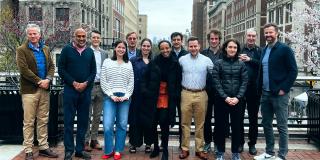
What are the social costs of climate change? Solomon Hsiang PhD ’11 should know. From 2023 to 2024, he served as the first chief environmental economist at the White House Office of Science and Technology Policy. He has also published widely on the human toll of a warming planet and is internationally recognized for his pioneering work quantifying the social costs of a warming planet, especially in relation to mortality and worsening inequalities.
The urgency for this kind of expertise cannot be overstated. As climate change intensifies, its effects reveal not just environmental vulnerabilities but profound inequities in how societies respond and adapt.
Now at Stanford, Hsiang is just one of the leading voices revolutionizing our understanding of climate science to hold a PhD from Columbia SIPA’s Sustainable Development program. Established in 2004, the program became the first in the country to bridge the natural and social sciences. SIPA’s program is truly interdisciplinary, combining rigorous economics training with deep expertise in engineering and environmental sciences. And its small cohort size—generally four to six per class year—allows doctoral candidates to partner closely with faculty and focus on understanding how natural and social systems interact. Students are taught to approach pressing sustainability challenges like climate change, public health, and resource scarcity as both scientific and societal issues.
“The biggest global problems [in sustainable development] are not just science problems or social problems,” says John Mutter, the program’s director of graduate studies and professor of earth and environmental sciences and of international and public affairs. “These issues exist at the critical nexus of multiple disciplines—physics, politics, policy—and to truly tackle them, researchers really need to be fluent in both natural and social sciences.”
Students take PhD-level courses in both economics and a natural science field, such as ecology or atmospheric chemistry, along with integrative seminars in sustainable development.
The program emphasizes not just technical and academic rigor but also research with real-world policy impact. Take the research of Anna Papp PhD ’25, another graduate of the program whose recent paper on the gig labor economy has drawn lots of attention. Her paper provided a striking case study of what happens when climate adaptation strategies—those meant to shield people from environmental harm—end up transferring that harm to vulnerable populations instead.
She examined transaction and labor data from food delivery services in Mexico, Germany, France, and the UK to analyze how the health burdens of extreme heat shift from richer consumers to poorer gig workers when temperatures soar. Like much of Hsiang’s research, Papp’s work highlights a stark reality facing policymakers: the ability of states and societies to adapt to climate change is highly unequal.
Students in the program often take classes in the University’s medical and public health schools. The goal is to educate researchers who do not just understand complex global systems but effectively communicate and develop solutions across disciplinary boundaries. Tomara Aldrich, the program’s coordinator, notes that one of its core strengths is preparing students to bridge disciplines, explaining that natural scientists and economists often overlap in the subjects they study but do not attend the same conferences or use the same methods. “There’s just not a lot of cross-pollination between those two disciplines,” Aldrich says. “They’re not talking to each other; they have different languages.”
That was partly the motivation behind a recent study led by R. Daniel “Danny” Bressler PhD ’25, Andrew Wilson PhD ’24, and SIPA associate professor Jeffrey Shrader. They analyzed mortality data from Mexico and wet-bulb temperature measurements, revealing that extreme heat disproportionately increases mortality among young people. Their findings, which showed that people under the age of 35 accounted for 75 percent of heat-related deaths, challenge traditional protective policies, which typically focus on safeguarding the elderly.
“One of the biggest challenges to understanding this issue is that relevant health and mortality data simply don’t exist in many places where we most want to study this question,” Shrader says. “This is a major public health tragedy. In places across sub-Saharan Africa and Southeast Asia that are very hot, humid, and have many people exposed through their occupation or otherwise, we just don’t have complete vital records to understand this issue.”
Graduates of the PhD in Sustainable Development program go on to secure high-level placements across academia, nonprofits, and international organizations. Others, like Kyle Meng PhD ’13, have also brought their expertise into the upper echelons of government. Meng, now an assistant professor at UC Santa Barbara, served as senior economist for climate, energy, and environment at the White House Council of Economic Advisers during the Biden administration.
Scott Barrett, Lenfest-Earth Institute Professor of Natural Resource Economics at SIPA, describes the program’s students as “innovators” at the frontier of research. “Our graduates are changing how other people are thinking about this kind of work, so it’s not just the work our people are doing, but the work the graduates are inspiring in the profession at large,” he says. “The way that this program amplifies and has an impact globally on how we think about the relationships between humans and development and the environment is pretty astonishing.”