Meet Moustapha Diallo MIA ’27: A Path from the UN to US Diplomacy
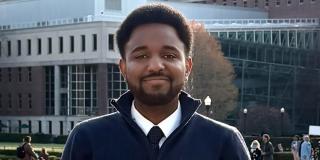
Moustapha Diallo is a first-year MIA student at Columbia University’s School of International and Public Affairs (SIPA), specializing in International Security and Diplomacy, graduating in spring 2027. Born in Guinea and raised as a naturalized American, his path to international affairs was shaped by witnessing political instability in West Africa and a deep belief in diplomacy’s power to advance peace and prosperity. Moustapha holds a bachelor’s degree in Political Science and International Studies from the City College of New York and studied abroad in France and Senegal. Prior to SIPA, he supported diplomatic initiatives in Burundi related to the conflict in Eastern DRC and coordinated a UN Resident Coordinators’ gathering in Geneva. He later served at the African Union Mission to the United Nations, working as a trainee on Peace and Security within the UN Security Council. A proud Rangel Fellow, Moustapha aspires to serve as a US diplomat, representing America abroad and forging partnerships across countries and regions in pursuit of a more peaceful and prosperous world.
Can you tell us a bit about your journey to SIPA and what drew you to pursue a Master of International Affairs?
While working at the African Union Mission to the United Nations, I met many professionals who had studied at SIPA. What stood out was that they were all guided by a strong sense of service and a shared commitment to making the world a better place. They spoke highly not only of the academic rigor but also of the diversity of backgrounds and perspectives within the program. For me, there is no better place for an aspiring diplomat to develop the skills needed to be effective. SIPA felt like a natural next step, one that would allow me to grow intellectually and professionally while being surrounded by people equally committed to public service.
You’ve had experience at the African Union Mission to the United Nations—what initially interested you in working in that space?
Growing up in Guinea, I witnessed firsthand the effects of political instability across West Africa. From an early age, I became fascinated by diplomacy and its ability to bring people together in moments of tension. I remember watching diplomats and special envoys from the African Union, the United Nations, and the United States engage parties in different capitals where there was disagreement. I was drawn to the seriousness, complexity, and quiet nature of that work, and to the hope it offered that dialogue could move people toward peace. That desire eventually led me to the African Union Mission. The experience confirmed for me that diplomacy is not only intellectually engaging but deeply important.
During your time as a Political Affairs Intern and later as a Peace and Security Trainee, what kind of work were you involved in, and what stood out most to you?
As a Political Affairs Intern, I supported the African Union in its coordination of the African Group—all 54 countries of the continent—at the United Nations. The African bloc is a powerful coalition, and as an African, I found it deeply fulfilling to contribute to that work. What stood out most was the unity and collective strength of such a diverse continent coming together around shared priorities such as development, health, and peace and security.
As a Peace and Security Trainee, I focused on the A3, the non-permanent African member states on the UN Security Council. This was during a period of significant global crises like eastern DRC, Gaza, Sudan, and Ukraine. I felt the weight of the moment and was privileged to work on real-life, real-time challenges. However frustrated I was by the lack of progress in ending those conflicts, the experience deepened my understanding of the critical role diplomacy plays in managing conflict and working toward a more peaceful world.
Was there a specific moment or experience at the UN that made you realize you wanted to pursue a career as a U.S. diplomat?
It was not a single moment, but an accumulation of experiences such as growing up in Guinea, immigrating to the United States, living in New York City, studying abroad, and ultimately working in diplomacy. Across this journey, I developed a sober understanding of the role the United States plays in shaping global outcomes and the importance of disciplined, principled engagement. As a naturalized American, I felt not only a responsibility to contribute to that effort but a genuine desire to represent America abroad, to serve and speak for a nation that I deeply love, and one that has made it possible for me to achieve everything I have as a first-generation college student. I am proud to be a Rangel Fellow at SIPA, getting ready to fulfill that goal.
Now that you’re at SIPA, how are you building on your UN experience—whether through coursework, internships, or other opportunities?
Being at SIPA has been a remarkable experience. I am specializing in International Security and Diplomacy, and I am being intentional about how I engage with both coursework and practice. In my first semester, I took International Security Policy with Professor Stephen Biddle, which strengthened how I think about the relationship between security policy and real-world decision-making. The course pushed me to move beyond theory and consistently ask whether a policy is not just sound on paper, but viable in practice. I am especially grateful for how the course has deepened my appreciation for the role of ethics in shaping responsible and effective security policy.
I am currently taking a course on the Failures and Successes of three decades of peacemaking with Professor Jean-Marie Guéhenno. His experience in conflict resolution, particularly on the African continent, has shaped how I think about multilateral interventions, their constraints, and the trade-offs they require. Together, these courses have helped me build a more grounded and critical approach to policy moving forward.
I am also the Secretary General for the SIPA Pan-African Network (SPAN), which has allowed me to help organize events around issues I am passionate about. Overall, my graduate experience is constantly enriched by the diversity of views I encounter through the wide-ranging perspectives that come with being involved in these communities—perspectives that consistently challenge and sharpen my own thinking.
For students interested in diplomacy or working at the UN, what advice would you give based on your experience?
Follow your heart. Diplomacy is a noble endeavor. Whether you pursue it through the UN or on behalf of your own nation, take it seriously and never hesitate to ask for help. As a first-generation college student, I would not be here without the guidance of my professors, mentors, and work supervisors, both at the City College of New York and in the professional spaces I’ve been fortunate to be part of. I went to them with my ideas, goals, and aspirations, and they helped me figure out how to achieve them.
At the UN, I learned that progress in international affairs is often slow, imperfect, and shaped by constraints, but that consistency and commitment still matter. That experience made me more grounded about what diplomacy actually requires. For those interested in the UN, apply to open positions and do not be discouraged by how difficult or uncertain the system can feel. Show up, do the work, stay engaged, and trust that your efforts place you among the professionals committed to building a better, safer, and more prosperous world.