Adrien’s Summer ISD Reading List
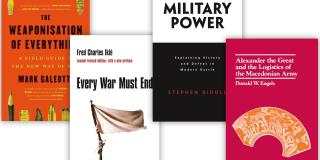
Looking to spend your summer productively, get ahead of the curve and set yourself up for success within SIPA’s ISD concentration ? Look no further.
Here are some of my reading recommendations based on books I’ve had the chance to read myself, faculty recommendations, and some of the readings you’ll find as part of flagship ISD classes. It goes without saying that any scholar of security policy should, in addition to the list provided below, have read Sun Tzu and Clausewitz (and Jomini!) but the goal here is to provide more breadth to prospective students – the classics won’t be discussed below.
Reading List
The Weaponisation of Everything, Mark Galeotti:
Hybrid warfare, grey-zone actions, operations below the threshold of war… As the tools of the 21st century have evolved, so have the ways and means through which political ends can be attained. If war is to be understood as the extension of politics by other means, then this book is a crucial pillar in understanding how war takes shape in today’s world beyond kinetic and traditional means. Of course, some of what is done today is simply an extension of past trends on steroids… but you’ll find out more about those nuances as you flip through the pages. From lawfare to culture, crime, and finance, the author does a good job of presenting some key concepts of international relations and international security, while exploring and settling many of the ongoing evolutions, challenges, and opportunities that arise with those new means of waging war.
Every War Must End, Fred Charles Iklé:
Fred Charles Iklé provides a short but essential reflection on the challenges of war termination. He explores the complexities of deterrence, recurring patterns of failed foreign policy, and the frictions that so often prevent wars from reaching a coherent end. Military power is squandered when strategy is divorced from the political objectives. Yet far too often leaders focus on how to wage wars rather than how to end them. This book will equip you nicely for the required Foundations of International Security Policy course.
Military Power, Professor Stephen Biddle:
A core reading which you’ll encounter as part of the Conduct of War class, Military Power is a masterpiece which delves deep into the nature of what produces military success in the field. It argues that force employment trumps all other characteristics of war as the most determining factor of success or failure, more than technology levels or the preponderance of fielded numbers of troops. The ability to implement what is called the modern system of combat is therefore paramount, but comes with associated tradeoffs which the author explores.
Beyond the argument, which is itself of great importance to the field, the methodology and analytical rigor of this work is of uniquely high quality, combining logical argumentation with case-study analysis, statistical models, and military simulations.
Alexander the Great and the Logistics of the Macedonian Army, Donald W. W. Engels:
It is easy to forget just how much of a challenge logistics have always posed in the conduct of wars, and continue to do so. It helps to dive back in time to the campaigns of Alexander The Great as the author highlights key logistical constraints of the time. From his armies’ marches planned around the timing of crop harvests to the disastrous consequences of flawed synchronization with the Macedonian navy, the book highlights just how the expansion of Macedonia was guided – and in some cases how key operational outcomes were decided – as a result of logistical considerations.
Though much of the analysis wouldn’t apply in exact terms to today’s logistical requirements (given considerable developments in available infrastructure and vehicles), it perfectly illustrates the maxim that whilst amateurs talk tactics, professionals study logistics.
French Connection
For the francophones and Francophiles in the room, I wanted to bring your attention to these few books (written in French) which have intrinsic links to the subject matter explored in ISD, and which will allow you to draw strong connections between course content and French policy and history.
La Radiologie et La Guerre, Marie Curie:
For those of you looking to merge the sciences with the study of security policy, I recommend taking the detour that La Radiologie et La Guerre offers. Written by Marie Curie herself, it recounts the scientific parameters of the early science of radiology and its uses on the frontlines of the Great War. There are, in addition, brief discussions about the organization of the sanitary corps of the French army, the composition of medical radiology teams and their operations. More generally, it is a great portrayal of the important junction between scientific advancements and its implications on military life.
We are lucky to be in possession of a copy of the book, in its original French, at the Rare Book & Manuscript Library on campus. Should you join us as a student, I highly recommend the visit (requires prior booking to access rare books).
Castelnau, Jean-Louis Thiériot:
This book takes us through the life of French General Castelnau, from his early career and his experience of combat in 1870–71, to the Great War of 1914–18, including the early days of the second world war before his passing.
The character is impressive – beyond his experience in all three wars – for his mastery of the art of war. Many of his reflections and recommendations for the French Army as early as his junior officer years were particularly astute. Much of the crucial changes in the conduct of war which were operated by the end of World War One had been theorized by Castelnau as early as 1915 (and many much earlier than that). Kept out of key leadership roles for political reasons, however, his sense of duty and his refusal to fight the powers that be offer a great moral dilemma to the readers, and raises the question: when is it our duty to disobey and contradict our hierarchies, particularly when so many lives were at stake?
You will find in this book parallels to many of the concepts studied in various ISD courses, applied to the unique experiences of one man’s life and career.